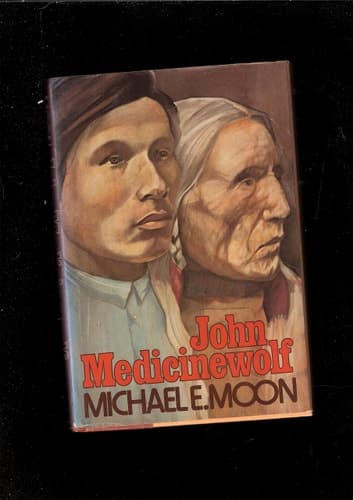
John Medicinewolf
John Medicinewolf by MICHAEL E. MOON "Occupation?" demands the questionnaire from the white man's world. "Paperboy," replies John Medicinewolf. Or, depending on his mood and on who's asking, he answers "buffalo hunter" or "writer" or "father" or "abstract fury." John Medicinewolf is the speaking voice and observing mind of this book. He is also most of the things he puts down on the questionnaires. He works at his various occupations, however, in ways that few white men could imagine. He actually is a paperboy, for example, but on an epic scale. His delivery route takes him by truck from western Montana over the Bitterroot Mountains into Idaho at Lost Trail Pass, where Lewis and Clark missed their way, then it meanders back along the Old Road that crosses and recrosses the Salmon River valley, until - twelve hours, six towns, innumerable creeks, and 350 miles later - it brings him again to his house near Missoula. As a hunter, John Medicinewolf scorns guns, shooting deer with a 45-pound bow and razor-sharp 28-inch arrows made by his wife. As a father in the Indian tradition, he waits to name his children until he knows what they're like, and he may never know their secret "medicine" names. As a writer, he draws on the oral traditions of his grandfather, Medicine Wolf, a Lakota tribesman who "knew stories stretching back to the dawn of time, who could read the clouds and animal tracks and hand-language and smoke, and most important, a man's heart," though he never learned to read the white man's writing. More than anything else, John Medicinewolf is a storyteller. His voice - quiet, ironic, dream-haunted - evokes, unforgettably, the life of the Salmon River valley.
Hardcover
160
Dial Press
1979
en
9780803742208