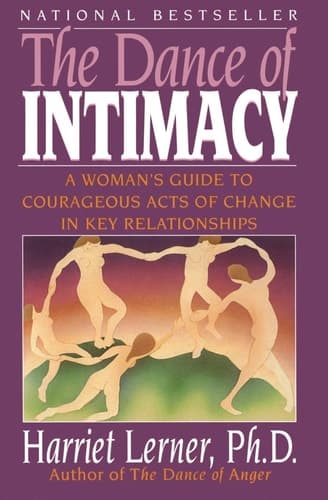
In The Dance of Intimacy, the bestselling author of The Dance of Anger outlines the steps to take so that good relationships can be strengthened and difficult ones can be healed. Taking a careful look at those relationships where intimacy is most challenged--by distance, intensity, or pain--she teaches us about the specific changes we can make to achieve a more solid sense of self and a more intimate connectedness with others. Combining clear advice with vivid case examples, Dr. Lerner offers us the most solid, helpful book on intimate relationships that both women and men may ever encounter.
I was cleaning my attic when I came across a poem I wrote during my sophomore year of college in Madison, Wisconsin. I vaguely recalled the brief attachment that inspired these lines - a steamy start which turned into an unbridgeable distance before either of us knew what was happening:
Once you held me so hardAll beginnings are lovely, a French proverb reminds us, but intimacy is not about that initial Velcro stage of relationships. It is when we stay in a relationship over time whether by necessity or choice-that our capacity for intimacy is truly put to the test. It is only in long-term relationships that we are called upon to navigate that delicate balance between separateness and connectedness and that we confront the challenge of sustaining both-without losing either when the going gets rough.
Nor is intimacy the same as intensity, although we are a culture that confuses these two words. Intense feelings-no matter how positive-are hardly a measure of true and enduring closeness. In fact, intense feelings may block us from taking a careful and objective look at the dance we are doing with significant people in our lives. And as my poem illustrates, intensetogetherness can easily flip into intense distance-or intense conflict, for that matter.
Finally, the challenge of intimacy is by no means limited to the subject of men, marriage, or romantic encounters, although some of us may equate intimacy with images of blissful heterosexual pairings. A primary commitment to a man reflects only one opportunity for intimacy in a world that is rich with possibilities for connectedness and attachment.
Whatever your own definition of intimacy, this book is designed to challenge and enlarge it. It will not teach you things to do to make him (or her) admire you. It does not provide guidelines for a love-in. It is not even about feeling close in the usual and immediate sense of the word. And certainly it is not about changing the other person, which is not possible. Instead, it is a book about making responsible and lasting changes that enhance our capacity for genuine closeness over the long haul.
Let's attempt a working definition of an intimate relationship. What does it require of us?
For starters, intimacy means that we can be who we are in a relationship, and allow the other person to do the same. Being who we are requires that we can talk openly about things that are important to us, that we take a clear position on where we stand on important emotional issues, and that we clarify the limits of what is acceptable and tolerable to us in a relationship. Allowing the other person to do the same means that we can stay emotionally connected to that other party who thinks, feels, and believes differently, without needing to change, convince, or fix the other.
An intimate relationship is one in which neither party silences, sacrifices, or betrays the self and each party expresses strength and vulnerability, weakness and competence in a balanced way.
Of course, there is much more to this business of navigating separateness (the I) and connectedness (the we), but I will avoid spelling it out in dry theory. The subject, in all of its complexity, will come to life in later chapters as we examine turning points in the lives of women who courageously changed their steps in relationship dances that were painful and going badly. In each case, these changes were made in the direction of defining a more whole and separate I. In each case, this work provided the foundation for a more intimate and gratifying we. In no case was change easy or comfortable.
In the chapters that follow, we will continue to evolve a new and more complex definition of intimacy, as well as guidelines for change that are based on a solid theory of how relationship patterns operate and why they get into trouble. The courageous acts of change that we will explore in detail are the differences that make a difference -the specific moves we can make with key persons in our lives that will most profoundly affect our sense of self and how we navigate closeness with others. Our goal will be to have relationships with both men and women that do not operate at the expense of the self, and to have a self that does not operate at the expense of the other. This is a tall order, or, more accurately, a lifelong challenge. But it is the heart and soul of intimacy.
I believe that women should approach all self-help books, including this one, with a healthy degree of skepticism. We are forever exhorted to change ourselves-to become better wives, lovers, or mothers-to attract men more or to need them less, to do better at balancing work and family, or to lose those ten extra pounds. There are already more than enough books in print for women who love too much, or not enough, or in the wrong way, or with a foolishly chosen partner. Surely, we do not need more of the same. Yet just as surely, on our own behalf, we may need to become more effective agents of change in our primary relationships.
Perhaps we should first take time to contemplate why tending to relationships, like changing diapers, is predominantly women's work. Caring about relationships, working on them, and upgrading our how-to skills have traditionally been women's domain. When something goes wrong, we are usually the first to react, to feel pain, to seek help, and to try to initiate change. This is not to say that women need relationships more than men do. Contrary to popular mythology, research has shown that women do far better alone than...

Paperback
272
HarperCollins
1990
Later Printing
en
Height: 8 Inches, Length: 5.31 Inches, Weight: 0.46076612758 Pounds, Width: 0.61 Inches
$15.99
9780060916466
9780060916466